Saturday, October 1, 2016

10 Bizarre Jewelry Items

Copyright 2016 by Gary L. Pullman

Jewelry has been around for thousands of years, long enough for just about every material on the planet—and some out of this world—to be used to make every imaginable type of body adornment. Or so one might suppose. However, imaginative designers have found some original substances or have used old ones in novel ways. The result is the creation of something original—and something, sometimes, that's downright shocking.

Makers of jewelry have used mineral, plant, animal, and, yes, even human materials to create earrings, necklaces, bracelets, pins, brooches, and other jewelry items. The possibilities seem endless, and some of them, as this list shows, are truly bizarre.

10 Roadkill

Kristin Bunyard of Austin, Texas, designs jewelry from animal bones. Most of her materials are supplied by roadkill. One item, a choker, was made of “rattlesnake vertebrae,” a skull “dangling in the middle.” She has also used “mixed media,” combining the bones of mice and snakes or “pearls” and an “armadillo tail.” After picking the bones out of the carcasses, Bunyard boils them before cleaning them with peroxide. She spends up to 30 hours on necklaces to ensure she cleans each bone “thoroughly” so there's no “lingering” odor. She's also made rosaries from rooster skulls and a “crown” from the backbone of a dog.

9 Recycled Barbie Parts

Eyes. Noses. Mouths. Hands. Arms. Breasts. These and other parts of Barbie are the materials artist Margaux Lange uses to create her necklaces, earrings, pins, and other jewelry items, securing the body parts in place using “hand-fabricated sterling silver and pigmented resins.” One of her pieces, the Barbie Heart Pendant, mounts five pairs of the doll's plastic breasts inside a wheel of heart-shaped frames fixed to a flower-like pentagram. If The Shoe Fits bracelet is a loop composed of many pairs of Barbie's silver high heels. Lange's line of recycled Barbie parts also includes a Winged Neckpiece made of the doll's arms; a Hands Bracelet; the Smiley Necklace on Torque, made of 29 smiling Barbie mouths; and earrings studded with Barbie ears.

8 Dead Relatives


Papua New Guinea's Angu people adorn some of their jewelry with objects which art dealer Ron Perry mistook for “tufted balls of fur.” When he asked a warrior what the decorations were, he discovered the “balls of fur” were, in reality, opossum testicles. Odd, yes, but the Angu's jewelry is made from even stranger stuff, such as necklaces strung with human fingers provided by “deceased relatives.” Their “smoked remains” are worn as adornments as a way of memorializing them, which explains the necklace made of the sternum of a man's late wife, the belts of “human leg bones,” and a necklace that included “the complete smoked hand of a baby.”

7 Human and Animal Bones


It appears Neanderthals were more aesthetic than anyone thought. They were also “more cognitively advanced,” Kansas University's professor emeritus of anthropology, David Frayer, said. The jewelry they created, mostly of human and animal bones, shows “a level of technical sophistication,” he added. Cut marks on the bones indicate they were fashioned together as items of jewelry. One piece, possibly a necklace, was made of eagle talons and a foot bone, or phalanx, and may have had religious significance.

6 Human Hair


Until 1925, hair jewelry was popular. Victorians, who also appreciated such of the finer things in life as “fans made out of preserved birds,” were especially fond of “hair work.” Men and women alike wore jewelry that incorporated snips of human hair. Men might wear items created using their wives' hair. Women might collect jewelry featuring the locks of their friends' hair. Rings, brooches, necklaces, “hair jewelry,” and other items were fashioned of such tresses, often as memorial pieces. Although hair jewelry is out of fashion now, “small organizations” remain “dedicated to preserving the craft of hairwork.” Who knows? It could become all the rage again someday.

5 Human Breast Milk


Lactating ladies who want to preserve a sample of their breast milk for posterity can do just that, thanks to Anne Marie Sharoupim, who started Mamma’s Liquid Love to make jewelry from women's mammary gland secretions. To show her appreciation for the breast milk a woman donated to her, Sharoupim made her a pendant from the woman's milk. The woman was so grateful and overjoyed, she said, to receive the pendant that Sharoupim decided to start a company dedicated to making such jewelry for all lactating ladies. The pendants are fitted with “a pearly white stone” that's really “breast milk preserved in resin.”

4 Human Blood
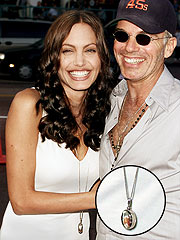

When she was married to Billy Bob Thornton, Angelina Jolie decided blood was thicker than separation. She and Thornton, both actors, were apart much of the time, making movies, Thornton explained in a speech to Loyola Marymount University's School of Film & Television students. Jolie bought twin “clear” lockets. She suggested it would be “romantic” for them to slice their fingertips with a razor blade and smear “a little blood” inside the lockets to “wear . . . around” their necks. That's all it amounted to, he insisted, but people blew the incident out of proportion until it sounded as if he and Jolie were “were wearing quart jars of blood around” their “necks and were “vampires” living “in a dungeon.”


3 Laurel Leaves


According to one of the half a million scraps of 1,900-year-old Egyptian papyrus known, collectively, as the Oxyrhynchus Papyri, which are housed in the Sackler Library at Oxford University, laurel leaves were woven or otherwise fashioned into jewelry, because “wearing a necklace made from the leaves of a shrub called Alexandrian laurel, also known as Poet’s laurel,” was believed to cure hangovers.


2 Meteorites

A bead, dating from between 3,350 B. C. and 3,600 B. C., and discovered “at an Egyptian burial site,” was made from an iron meteorite. For thousands of years, meteorites have been used to make ancient jewelry and other artifacts, partly because ancient and medieval people believed such stones promoted healing: in particular, “iron meteorites” brought “balance and strength,” and “the nickel in” them purified “the wearer’s blood.” Today, silvery “cross-sectional” fragments of the metal are “mounted in a bezel setting” and used in watches, necklaces, bracelets, and rings.

1 Dinosaur Fossils


Boutique owner Gina Johnson Morris thought there must be better uses for the fossilizedbones of dinosaurs than to be stored in the basement of Montana's Makoshika Dinosaur Museum, even if the specimens weren't in good enough condition for educational or display purposes, so she teamed up with the museum. Now, the museum provides her with the material to make her dinosaur jewelry, and they split the profits. Morris has turned a fragment of Triceratops into a pendant, fashioned Hadrosaur vertabrae into earrings, and transformed bits of Hadrosaur eggshells into necklaces. Each of her pieces, she says, is a “65-million-year-old heirloom.” She also transforms fragments of teeth, tusks, tortoise shells, and tails into jewelry, according to how best to “display the fossils' features.”

10 Macabre Maladies

Copyright 2016 by Gary L. Pullman

Overnight geniuses. Strange perceptions about one's body. Unawareness about the loss of one's vision. These are only a few of the strange effects of rare, often mysterious, illnesses. Some of these diseases are organic, and their causes are discernible on brain scans or by means of other testing procedures. Others are emotional, or “affective.” Trauma or disease accounts for the onset of a some symptoms, and several of these ailments are associated with other medical problems or psychological disorders. Some can be cured. Others can be treated. In a few unfortunate cases, there only palliative care is available. Each of these conditions has one thing in common with the rest” all 10 are macabre maladies.

10 Acquired Savant Syndrome

Acquired savant syndrome is a condition in which a normal person becomes an instant genius concerning a particular subject as the result of severe trauma or disease. After two men brutally assaulted him outside a karoke bar, Jason Padgett, a furniture salesman, became a mathematical genius. He recalls being knocked out briefly and “seeing a bright flash of light.” His assailants beat him and kicked him in the head. As a result, he suffered “a severe concussion and a bleeding kidney.” His vision was also altered. It became pixilated, and he saw things as if they were still photographs joined to one another by a line. “Every shape” appears to be “a finite construction of smaller and smaller units.” He also developed synesthesia, which allows him to see “mathematical formulas as geometric figures.” Padgett, who had never done well at math before his injuries, is now in college. He plans to become a numbers theorist. 

9 Alice-in-Wonderland Syndrome


People who suffer from the Alice-in-Wonderland Syndrome (aka a Lilliputian hallucination) experience distortions of time, space, and body image, feeling their entire body or parts of it have been altered in shape and size.” Typically, their perceptions are accompanied by “visual hallucinations” and a family history of migraine headaches. The English psychiatrist, John Todd (1914-1987) who discovered the malady named it after the Lewis Carroll novel,
Alice in Wonderland, whose main character experiences similar perceptions. 

8 Anton-Babinski Syndrome

Blind people who have Anton-Babinski syndrome are blind deny they are blind. The rare condition, which is also known as reversible cortical blindness and transient Anton's syndrome, should be “highly suspected” when an individual experiences “odd vision loss” or a brain scan indicates injury to the occipital lobe. The syndrome is often associated with brain injury or strokes. In one case, a 90-year-old man, who was blind in both eyes, had false memories related to vision, and was unaware of his condition, was diagnosed with Anton-Babinski syndrome. During the course of a week, he “gradually realized he was blind.” In another case, a patient became aware of being blind in two weeks. These cases show that the effects of Anton-Babinski syndrome need not be permanent.

7 Auto-brewery Syndrome 

Matthew Hogg, age 34, of Middlesbrough, England, is a human brewery, able to convert starchy foods into alcohol. Due to “an excess of yeast in his digestive system,” Hogg gets drunk on such foods as “bread and pasta.” As a result, he was often drunk or hungover and routinely experienced fatigue. At first, doctors were baffled by his condition, but after he spent $80,000 in medical testing, a Mexican doctor diagnosed Hogg with the auto-brewery syndrome (aka gut fermentation syndrome). Now, Hogg is on a strict diet, although he remains too exhausted to work full time. 

6 Capgras Syndrome

People with Capras syndrome, a condition named for the French psychiatrist, Jean Marie Capgras, who discovered it, strongly believe their family and friends are impostors. Deluded, they think significant others are doubles, they themselves are doubles, or both. They may also believe animals are impostors or inanimate objects are doubles. Such individuals are not hallucinating, because they are aware of their perceptions. Capras syndrome may also feature cerebral lesions as the result of head trauma, schizophrenia “conditions,” or emotional or “organic-psychic disturbances.” The syndrome is also known as delusional misidentification, illusion of doubles, illusion of negative doubles, misidentification syndrome, nonrecognition syndrome, phantom double syndrome, and subjective doubles syndrome. 

5 Exploding Head Syndrome

The heads of those who have the exploding head syndrome don't actually explode. Instead, they hear loud noises as they drift into sleep or awaken. They compare the noises to exploding bombs, gunshots, and crashing cymbals. Although the condition doesn't cause pain, it frightens and confuses those who hear these sounds. Exploding head syndrome is often accompanied by heart palpitations and a rapid pulse. About 10 percent suffer from the syndrome, which affects women more than it does men. The cause of the condition is unknown, although it may result from “minor temporal lobe seizures, from “sudden shifts of middle ear components,” or from stress or anxiety, “calcium signaling” impairments, or “brainstem neuronal dysfunction.” Unless individuals suffer from sleep deprivation, no medical treatment is prescribed for the macabre malady.

4 Fish Odor Syndrome 

Trimethylaminuria (aka fish odor syndrome) is characterized by the body's inability to break down the chemical compound known as trimethylaminuria. As a result, a person with this syndrome excretes an excessive amount of the compound in his or her “urine, sweat, and breath.” The syndrome is caused by a genetic mutation, and its “symptoms are often present form birth.” Although uncommon, it's not a condition easily hidden or ignored, because the odor it causes is like that or “rotting fish.” Fortunately, the macabre malady responds favorably to “dietary restrictions” and the use of “acid lotions and soaps, . . . activated charcoal and copper chlorophyllin, certain antibiotics, laxatives, and riboflavin supplements. 


3 Fregoli Syndrome


Fregoli syndrome, discovered in 1927, is the opposite of Capras syndrome: a stranger is impersonating a friend or family member. Schizophrenics may develop the condition, as was the case with a patient identified as “Mr. A.” He believed co-ed students were “strongly attracted” to his “facial cream,” the use of which gave him a perfect appearance. After spending an inordinate amount of time flirting with a young woman he encountered on Facebook, He spent an excessive amount of time on Facebook, only to have her break off their online relationship, Mr. A believed she'd “been in contact” with him previously and “now was disguising herself.” He was also convinced she used “the same cream as he did himself to transform her facial looks” and was still “interested in pursuing a relationship with him.” Brain scans showed no organic “abnormalities.” One of the causes of Fregoli's syndrome is a “breakdown” in the affected individual's ability to see individuals as unique.

2 Stereo Blindness

Stereo blindness results from a lack of alignment between the eyes which prevents the brain from combining the image seen by each eye into a single picture. This malady may actually benefit artists, research suggests. In an experiment, art school students wore 3-D glasses before staring “at a background of colored dots that were manipulated by a computer to flicker randomly.” Those who wore the 3-D glasses and, as a result, possessed stereoscopic vision, could discern “a square floating in front of or behind the computer screen,” whereas students who were stereo blind “just saw noise.” Another experiment demonstrated that, more often than not, artists are stereo blind. As a result, they enjoy “a natural advantage in translating the richly three-dimensional world onto a flat two-dimensional canvas,” Harvard Medical School vision expert Margaret S. Livingstone said.

1 Stone Man Syndrome

Fibrodysplasiaossificans progressiva (aka stone man syndrome) transforms connective tissues, such as muscles, ligaments, and tendons, into bone. The macabre malady is rare, but a one-year-old Oklahoma boy, Ryder Kirkman, has it. His mother, Chastity, was aware her son had a problem when she noticed his “fingers and toes weren't fully developed.” A fall can prompt bone growth, as can an attempt to remove it. Unfortunately, there's no cure for the ailment, although those who suffer from it survive into their forties.

An older person with the syndrome, 20-year-old Seanie Nammock, of Birmingham, England, is and has had the disease for six years. Essentially, “a second skeleton” is “growing inside her,” atop her original set of bones. Her “back and neck are frozen already,” and she can't “lift her hands above her waist.” Eventually, she'll be forced to lie or sit for the rest of her life, because her whole body will be too rigid for her to move. Her inability to hold the banister when she climbs or descends stairs and her shaky balance has caused her to fall several times, and she's unable to break her fall by putting her arms down. Worse yet, each fall tends to spur more painful, unwanted bone growth. Nammock's only recourse against the progressive disease is “over-the-counter painkillers.”